 Mobility
What the trackers have found so far
MobilityGuard is in beta on a small number of scooters in Kent. These are real things it spotted, with the real readings behind them. We've left out names and places.
- Tracker reads the batteryPack volts, every few minutes, around the clock
- Every charge and ride is checkedAgainst what a healthy pack and charger should do
- Something's offThe dealer gets an alert with the reason
- Fixed before it strands someoneA phone call or a visit, not a breakdown
A charger that never finished a charge
A 60 V scooter (five 12 V batteries) in Kent, fitted on the first day of the beta.
- What the rider saw
- The charger light stayed red, even after a whole afternoon and evening on charge. The scooter seemed fine.
- What MobilityGuard saw
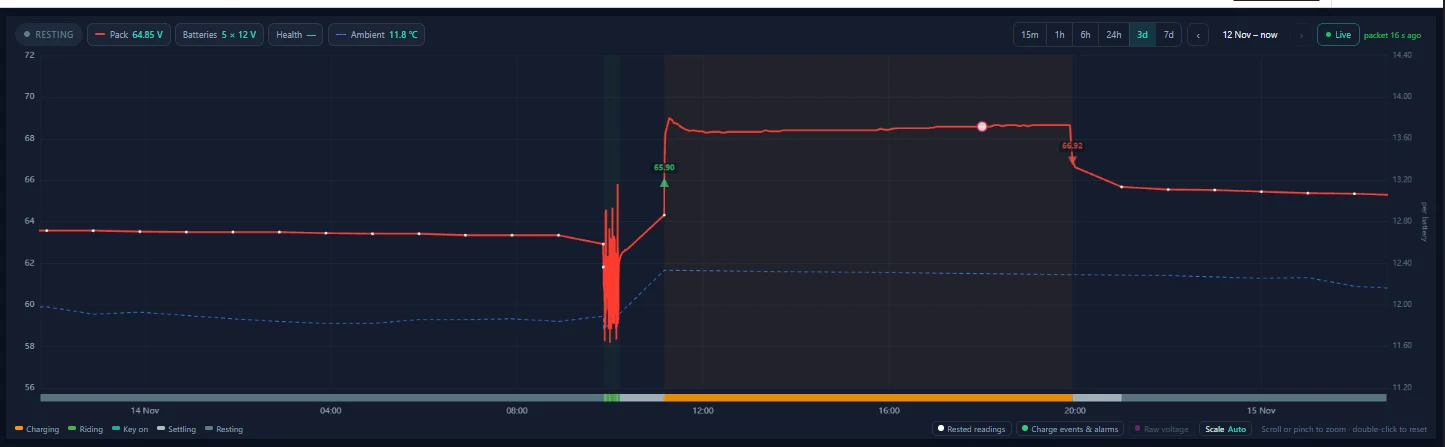
- Every full charge since fitting stopped between 68.4 V and 69.0 V. Five lead-acid batteries need about 72 to 73 V to finish charging. This charger was holding them at about 13.7 V each, a "keep topped up" level, and never gave them the final push.
- Why it matters
- Lead-acid batteries that are never fully charged lose capacity over months (sulphation). Range shrinks and the batteries need replacing early, and nobody notices until the scooter stops short.
- What we did
- The Charger fault alert went to the dealer within days. We advised swapping to a proper 60 V lead-acid charger.
Status: fixed. The charger has been swapped. See the first charge on the new one.
After the swap: the charge finishes
Same scooter, same batteries. The first charge on a proper 60 V lead-acid charger, 20 November.
- The full-charge push
- Within two minutes of plugging in, the pack was at 72.1 V and it kept climbing to 72.7 V, about 14.5 V per battery. The old charger never got past 69.0 V.
- Then it eased off by itself
- After 1 h 12 min at the top, the charger dropped to 68.3 V (about 13.65 V per battery) to keep the batteries topped up. That's the level the old charger sat at all along: it only ever did the "keep topped up" step, never the push before it.
- What MobilityGuard saw
- A complete charge, recognised as full. No Charger fault alert since the swap.
Status: fixed. The new charger does exactly what a lead-acid charger should, and the batteries now get a full charge.
Through to late November, one test scooter is doing the same short daily route on a good set of batteries, then a worn set, then the good set again. The aim: see how early MobilityGuard can tell a tired battery from a healthy one. More real faults go here as the beta finds them.